Welcome To Healthysport!
ANY MOVEMENT WILL DO: Rethinking Exercise, Aging, and Quality of Life
- Details
- Written by: Healthysport
- Hits: 1420

Retirement often brings a welcome sense of freedom. For many older adults, its greatest gift is the ability to control their own time—sleep when they wish, rise when they choose, and explore hobbies that work life once made difficult. Yet retirement also comes with its own challenges: increased sedentary time, boredom, and the temptation to take on activities that may not match one’s physical capabilities.
As people age, medical issues they are genetically predisposed to can begin to surface. Regular medical visits, new medications, and ongoing health monitoring become common parts of life. Some older adults remain remarkably healthy into their 80s or 90s, but these individuals are exceptions. Studies consistently show that genetics play a role in aging, but lifestyle, environment, and random chance play equally powerful roles in determining long-term health outcomes.
Most retirees fall somewhere between these extremes—not elite athletes, but everyday individuals trying to maintain wellness with the body they have. For many, acceptance becomes a form of wisdom: knowing one’s limits, adjusting expectations, and finding joy in what is still possible.
Individuality Matters: One Size Does Not Fit All
After decades working as a physical therapist, many clinicians like me observe the same truth: no two older adults are alike. What works for one person may be inappropriate for another. Effective exercise programs must be tailored not only around medical conditions, but also around blood pressure, breathing tolerance, fatigue levels, past injuries, body weight, and overall age-related decline.
Research supports this individualized approach. The American College of Sports Medicine (ACSM) emphasizes that exercise prescription for older adults must consider functional limitations, chronic diseases, and personal goals, warning that generalized routines may increase risk of injury (ACSM Guidelines for Exercise Testing and Prescription, 2021).
The guiding principle becomes appropriation, modification, and moderation—adjusting activities based on what the body can safely do.
The Reality of Aging: Illness Is Not a Moral Failure
Even among physically active individuals, chronic illnesses can still appear. For example, type 2 diabetes has a strong genetic component; those with family history remain at elevated risk despite lifestyle modifications. A major study published in The Lancet Diabetes & Endocrinology found that genetics explain up to 40–60% of diabetes susceptibility, meaning even healthy, active adults can develop the disease.
Similarly, chronic conditions such as hypertension, cancer, heart disease, Parkinson’s disease, and autoimmune disorders often emerge simply because of aging. Illness is not a failure—it is a biological reality.
The question becomes: How can quality of life be preserved despite these conditions?
Quality of Life Over Quantity
When serious illness strikes—stroke, heart attack, diabetic complications, cancer, or age-related neurological decline—the most important measure becomes independence.
Can an older adult still:
-
Get to the bathroom safely?
-
Bathe and dress without losing balance?
-
Prepare meals without assistance?
-
Drive or walk to the store?
-
Maintain social relationships?
-
Move around the home safely and confidently?
These basic tasks—known as Activities of Daily Living (ADLs)—are the foundation of dignity in aging. Research published in The Journal of Gerontology repeatedly shows that mobility predicts independence more accurately than almost any other health measure, including blood tests or imaging results.
Once mobility declines, overall quality of life often declines with it.
Redefining “Exercise” in Older Age
Most people imagine exercise as gym workouts, running, or lifting weights. But aging changes the definition of exercise entirely.
For older adults, exercise can include:
-
Walking from one room to another
-
Strolling through a mall
-
Light gardening
-
Folding laundry
-
Tidying a bedroom
-
Cooking meals
-
Watering plants
-
Rearranging bedding
-
Taking stairs slowly
-
Doing simple home projects
In later life, any movement counts. Even low-intensity daily activities contribute to better health.
A landmark study published in JAMA Network Open (2019) found that light physical activity reduced mortality risk by 41% in older adults, compared to those who were sedentary. Surprisingly, light activity was nearly as beneficial as moderate activity, and much more sustainable.
Similarly, a major 2022 systematic review by the National Institutes of Health (NIH) concluded that small amounts of daily movement significantly improve cardiovascular health, reduce inflammation, and preserve mobility, particularly in adults over 65.
Why Moderation Works Best
Moderation is not only safer—it may actually provide better results.
Studies show:
-
Too little activity increases the risk of heart disease, stroke, and disability.
-
Excessive high-intensity exercise in older adults can trigger inflammation, joint damage, arrhythmias, and elevated stress hormones.
-
Moderate daily activity produces the strongest long-term health benefits.
A large study in Circulation (2021) found that adults performing moderate activity 150–300 minutes per week had significantly lower mortality rates than those who performed extreme high-intensity exercise.
Moderation protects the heart, joints, and immune system—especially for those recovering from illness or managing chronic disease.
The Digital Problem: The Internet Pushes Extremes
One challenge today is that social media promotes extreme fitness trends that rarely apply to older bodies. “One-size-fits-all” workouts designed for 20-year-olds are marketed as universal solutions. This cultural pressure often leads older adults to overexert themselves, risking falls, cardiac issues, and injury.
Studies show that older adults exposed to aggressive fitness content online are more likely to engage in unsafe exercise behaviors, according to a 2023 study in The Gerontologist.
Moderation and common sense counterbalance this pressure.
The Bottom Line: Any Movement Will Do
In aging, mobility becomes the currency of independence. Maintaining simple, consistent physical activity—no matter how small—helps support:
-
heart health
-
blood sugar control
-
balance and fall prevention
-
joint mobility
-
cognitive function
-
emotional well-being
-
independence in daily tasks
The goal is not to become an athlete in later life. The goal is to move consistently, joyfully, safely, and within one’s capabilities.
Aging may bring unavoidable illnesses, but with thoughtful movement, moderation, and self-awareness, older adults can preserve the most precious gift of all: a life lived with dignity, independence, and meaningful daily function.
Reflection Tuesday Morning
- Details
- Written by: Healthysport
- Hits: 1529
John 20:18–20
18 Mary Magdalene went to the disciples with the news: “I have seen the Lord!” And she told them that he had said these things to her.
Jesus Appears to His Disciples
19 On the evening of that first day of the week, when the disciples were together, with the doors locked for fear of the Jewish leaders, Jesus came and stood among them and said, “Peace be with you!” 20 After he said this, he showed them his hands and side. The disciples were overjoyed when they saw the Lord.
The resurrection of Christ is truly the greatest story ever told. When I first encountered it as a young boy, it stirred a deep excitement in me—so much so that I dreamed of becoming a monk or a priest. I remember the old films about Christ’s passion, death, and resurrection, filled with miracles and wonder. In my young mind, the world suddenly seemed perfect and pure, with good and evil clearly defined and goodness destined to triumph.
Now, decades later, I find myself in my sixties—sailing through what I call the winter of life—facing health challenges and physical limitations that shadow the remaining years of retirement. I am not naturally drawn to recollection or meditation, yet the narrowing horizon of time pushes me to reflect.
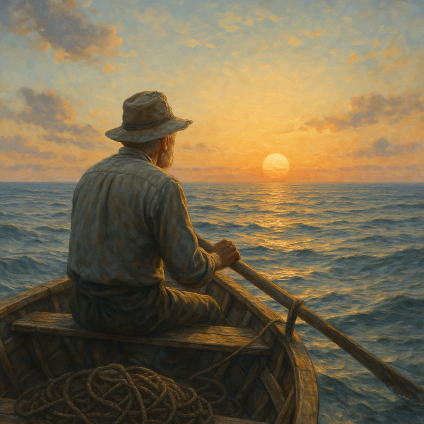
Still, I keep paddling my small boat along, like an old fisherman who continues to sail out to sea even when there are no more fish to catch—or when his strength no longer allows him to haul them in as before. Each morning, he readies his boat and his net. Though his catch is small, he goes because it is not the fish that matters anymore. It is the sea itself—the vast horizon, the blue clouds, the play of light—that keeps him alive. His body has grown frail, but his love for the sea endures. Watching the younger fishermen, sharing their joys and disappointments, he feels content.
I wake up each morning grateful for another peaceful night. It took me a long time to regain proper sleep after years of carelessness with my hours. When I first retired, I assumed that freedom from work would mean peace: no more early alarms, no commutes, no deadlines, no bosses to please, no clients to satisfy. I imagined a quiet rhythm—coffee, reading, maybe a walk.
But instead of peace, retirement first brought chaos. I was like a child left alone in a candy store, free to take anything I wanted. I wanted to read, travel, learn, build projects, garden, exercise, take classes, learn new languages, fix the house, drive around, post on social media, and experiment with digital art and AI. I wanted to do everything.
And I did—until I was exhausted.
Freedom without structure became its own prison. My sleep worsened. My projects piled up unfinished. Books remained half-read. Social media became repetitive. Travel lost its appeal. Friends were busy with work and families. Hobbies multiplied but none gave lasting joy.
Eventually, life felt heavy and cluttered—with too much baggage and too little peace.
The only solution I found was letting go.
Social media? Who really wants to see my daily routines?
Reading every book? Impossible.
Relearning programming? That’s a recipe for immobility and fatigue.
Streaming shows all day? A quick path to decline.
Collecting hobbies? A drain of time, money, and energy.
Peace came only when I started pruning the excess. Like the old fisherman, I learned to venture into the sea not for the catch but for the wonder—the sunrise, the horizon, the closeness to God.
In old age, the mind turns naturally toward contemplation, nostalgia, and grief. I have lost many loved ones. Each familiar road or memory can still bring me to tears. I avoid the routes I once took with my late sister. I hesitate to visit Fort Lauderdale, where my best friend now battles cancer. Loss becomes the rhythm of aging, and perhaps my constant search for new things is only a way to cope—to distract myself from pain.
There is a sword that hangs above every life, unseen yet certain. But within suffering lies truth. Loss teaches us to understand and live rightly. None of us can predict tomorrow. I never imagined I would outlive my sister—ten years younger than me—or my best friend, seven years my junior. Life’s unpredictability is the signature of God, the Master of Mystery.
Yet God, in His constancy, keeps the world in order. The sun, the moon, the sea, and the changing seasons—these remain steady. Humanity rises and falls, but Nature abides. Its predictability reminds me of divine order even amid chaos.
If I focus only on my personal struggles, I lose sight of this greater harmony. To fear aging or death, to cling to safety and control, is to resist the natural rhythm of life. I now seek to embrace what God has written for me.
I can save money, build security, surround myself with professionals and friends, and still feel lost—because I see only the solitary tree, not the forest. Self-absorption blinds us to God’s design. When we overthink, overwork, or overprepare, we forget to live.
The Bible tells of a man who asked Jesus how to enter the Kingdom of Heaven. Jesus told him to leave his treasures and follow Him. The man turned away—unable to let go.
Where our treasure is, there our heart will be also.
For me, a modest life is enough. Like that old fisherman, I rise each morning, venture into the open sea of life, cast my net, and accept whatever comes. Even when the net is empty, I find peace in the sunrise, the clouds, the moon, and the stars. Sometimes, there is a surprise waiting.
Mary Magdalene went to the tomb expecting nothing but sorrow—and yet she proclaimed the most wondrous truth in history: “I have seen the Lord!”
That is the mystery, the miracle, the forest beyond the tree.
What seems random to us is perfectly designed by God.
- The Gradual Shift
- Retirement: Disowning, Downsizing, Trimming
- Reflection on this Sunday Morning
- Advocacy
- The Mitigation
- Retirement Hobbies and Self Expression
- Cognitive Health: The Other Half of Aging Well
- The Weight of Aging and the Gift of Recovery
- Importance of Rotational movements
- Endurance in the Later Years
Page 6 of 93